
The Macro Endgame: Navigating the Physical and Financial Bottlenecks
A deep dive into the four structural shifts rewriting the rules of investing, plus a first look at the new AI Capital Flow Monitor.

As I mentioned in my previous note, I am taking a step back from the screens this week to recharge. While my first reading list focused on navigating immediate market volatility and the ongoing capital rotation, today I want to zoom out and concentrate on those megatrends which will shape our investment decisions for years to come.
These megatrends are:
Physical constraints and the electrification bottleneck
Sovereign debt and modern financial repression
Structural inflation volatility (the Rug-Pull Regime)
Geopolitical supply chain fragmentation
At the end of this note, I will also share a quick preview of what comes next and the new systems we are building at Defy the Odds to track these shifts.
1. The Physical Constraint: Electrification and the Copper Bottleneck
The transition to AI and green energy is colliding with a hard physical ceiling. Total electricity use is growing significantly faster than traditional GDP-linked models allow. The true crisis sits in the 2030s when the operating base of existing copper mines melts down, leaving a deficit that a high price today cannot quickly fix.
To trade this reality without getting shaken out by cyclical volatility, you need to read the financial plumbing. Our framework utilizes metrics like the China Credit Impulse and the AUD/JPY cross to separate cyclical forces from structural signals, telling us exactly when to buy the deficit.
Wiring the Megatrends: The Copper Constraint on AI and Electrification

Reading the Plumbing: When to Buy the Copper Deficit

2. The Sovereign Debt Endgame and Financial Repression
The US debt problem is fundamentally misunderstood. The US spends like Canada but taxes far less, driven heavily by healthcare costs and demographics. This forces a hard decision point in the early 2030s when major trust funds deplete. The government cannot default, so it must innovate. Warsh is utilizing five task forces to quietly reshape the Fed and build the plumbing for modern financial repression. The goal is to make government bonds so cheap to hold that captive demand absorbs the debt.
Mapping the Point of No Return for US Debt: Why It Arrives in the Early 2030s

Five Task Forces, One Agenda: Warsh’s Blueprint for Reshaping the Fed by Proxy

3. The Rug-Pull Inflation Regime
Forget a straight-line repeat of the 1970s. We are entering the Rug-Pull Inflation Regime, a volatile era where a 2.5% to 3.0% base is violently punctuated by 5.0% to 6.0% spikes. The disinflationary pull of AI and China is locked in a tug-of-war with the inflationary push of massive capital expenditure and global fiscal dominance. In this environment, “buy and hold” is dead. You have to master the rotation and that idea shaped how Defy the Odds looks at markets.
The new Rug-Pull Inflation Regime: The End of Stability

4. The Geopolitical Fracture of Supply Chains
The war with Iran is not just an oil shock and the disruption does not arrive all at once; it moves sequentially from LNG and helium to diesel and petrochemicals. This creates a timeline where critical industries face physical shutdowns, not just higher costs. Understanding this sequence allows you to position your portfolio before the downstream damage hits the broader market.
Mapping the Damage from the Iran War I: The Timeline of the Supply Chain Shock

What Comes Next
These materials cover four primary megatrends that will dictate market returns for the foreseeable future. But we are just getting started.
Looking ahead, we will expand our coverage to include the next wave of structural shifts, categorized into three distinct pillars:
1. The Physical Reality
Nuclear Renaissance and Baseload Energy: The realization that the AI and green energy transitions cannot survive without round-the-clock nuclear power.
Resource Nationalism: The weaponization of critical minerals beyond copper, from uranium to rare earths.
The US-Europe Decoupling: How shifting trade policies, capital flight, and industrial subsidies are permanently fracturing the transatlantic economic alliance.
2. The Financial Plumbing
The Mechanics of Modern Financial Repression: How the state quietly forces captive demand for its debt, and whether stealth yield control can actually survive in a highly financialized 21st-century market.
3. The AI and Technology Layer
Sovereign AI and the Physical Compute Bottleneck: Why nation-states are beginning to hoard compute infrastructure like strategic reserves, and how advanced packaging and liquid cooling are becoming the new geopolitical chokepoints.
Defense Technology and Dual-Use Infrastructure: The structural tailwind for aerospace and defense tech driven by a fragmenting global order and autonomous systems.
The Engine Under the Hood: The AI Capital Flow Monitor
On Monday, we mapped the tactical capital rotation. Today, we laid out the structural megatrends. But understanding the macroeconomic theory is only half the battle. You have to track the execution in real time.
That is why I want to share something we have been building quietly behind the scenes at Defy the Odds.
To capture the defining theme of this decade, we are developing the AI Capital Flow Monitor. This is a systematic tracking engine designed to spot capital rotations within the AI space.
Right now, we are operating in Stage 1. This is a purely price-based layer that tracks 20 distinct nodes across the global semiconductor and hardware space. It continuously answers three critical questions:
which nodes is capital moving into,
is the move broad or narrow,
and what exactly has changed since our last evaluation?
It mathematically flags early capital rotations and structural leadership without relying on media narratives.
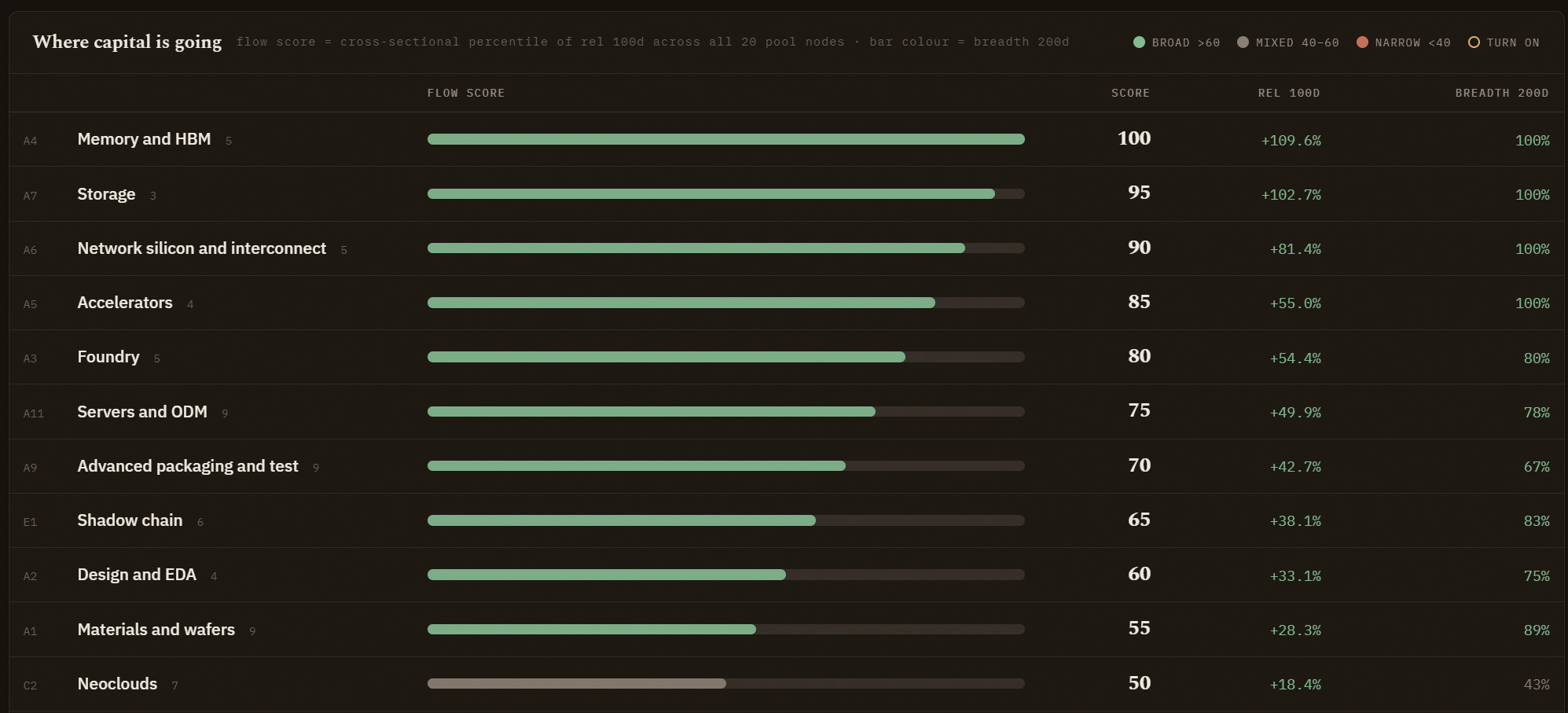
But this is just the foundation. We are actively building Stage 2 and Stage 3.
These will integrate the physical reality into the model. This means plugging in hard macroeconomic data, TSMC monthly revenue figures, global export and import volumes, and shifting analyst estimates. Once complete, it will give us a real-time, structural pulse on the entire AI value chain.
We are not reinventing the wheel here. We are doing exactly what Michael Burry did before the 2008 financial crisis
We are digging deep into the unglamorous, tedious data that everyone else skips because they find it too boring. We are systematically checking the plumbing of the market, day after day, to find the structural truths hidden underneath the daily price action.
This monitor is being designed to seamlessly complement our existing institutional frameworks, like the Intermarket Macro Map and the DTO Cycle Allocator and the stock selection screeners we use.
It will run quietly in the background, doing the heavy data lifting and powering the next evolution of our macro research.
I will share more details on the final rollout and how to access this system in the coming months.
Enjoy the deep dives, and I will be back in next week.
Glossary for Defy the Odds is here.
Disclaimer: Nothing here is financial advice. These are reflections on macroeconomics and markets, meant to spark ideas and sharpen decision-making. To truly Defy the Odds, think independently, question everything, and do your own homework.