
Weekly AI Capital Flows: The Hardware Stack Synchronizes
Tracking the widening gap between hard-asset demand and weak AI monetization.

What is the Weekly AI Capital Flows?
AI is a massive, structural reallocation of global capital. This super-cycle will either bury equities under unprofitable infrastructure or mint generational wealth for those positioned on the right side of the build-out.
This weekly publication tracks the AI ecosystem through intermarket analysis. I built a proprietary framework that maps institutional capital across six phases of the AI value chain, then measures the relationships between those phases through custom ratios called Bridges.
The objective is simple: identify where capital is flowing, where bottlenecks are tightening, and where the market is demanding proof instead of promises.
The Six Phases of the AI Value Chain
Phase 1: Upstream (Chemicals, Materials, Wafer, EDA)
Phase 2: Core Silicon (Accelerators, Networking, HBM, Foundries)
Phase 3: CapEx (Front-End and Advanced Back-End Equipment)
Phase 4: Compute Hardware (Servers, Optics, Power, Cooling)
Phase 5: Heavy Infra (Grid, Data Center REITs, Private Credit)
Phase 6: Payoff (Hyperscalers, AI Software, Monetization)
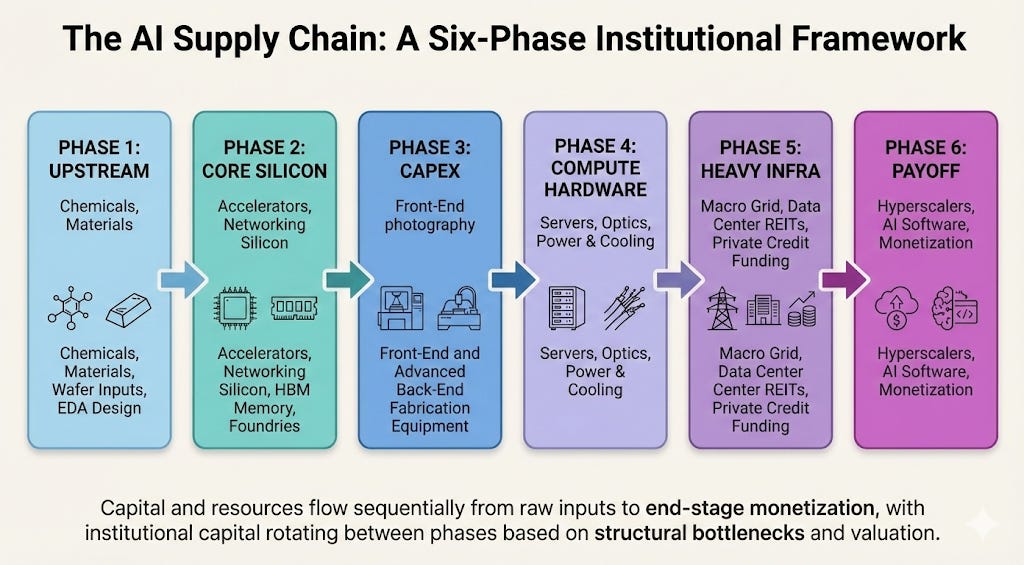
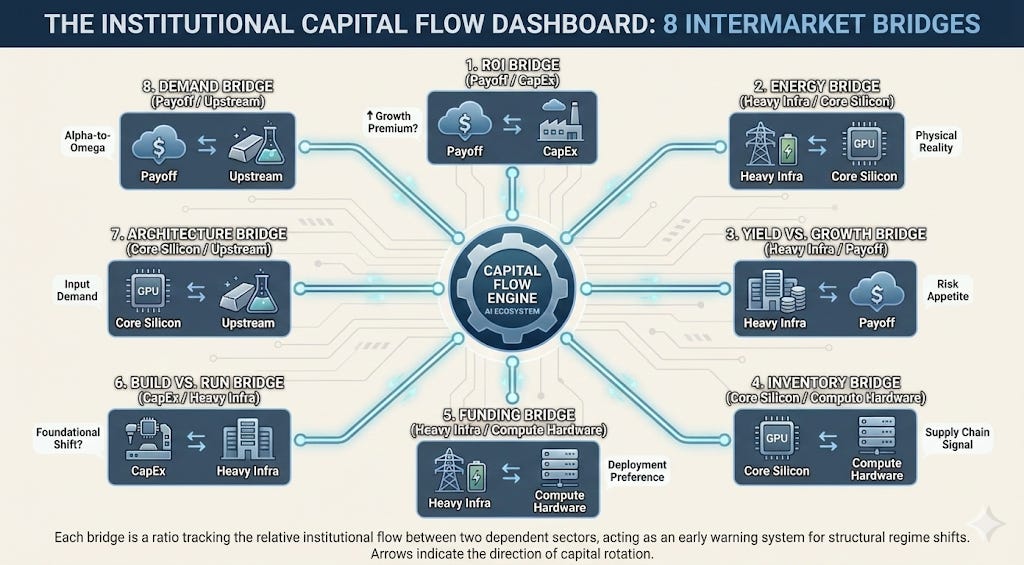
The framework also tracks eight Bridges that compare one phase against another. These ratios function as an early warning system. They reveal where opportunity cost is rising, where capital is rotating, and where the economic logic of the AI build-out is strengthening or breaking down.
Defy the Odds is soon transitioning to a paid model.
To lock in your access before the transition, Pledge your support today.
(Enter your email to see the pledge options)
The AI Supply Chain in 60 Seconds: Atoms Over Bits
The market is sending an absolute signal: physical scarcity dictates capital flow.
Institutional liquidity continues to aggressively hunt solutions to hard physical constraints, pouring into memory, foundries, fabrication equipment, optics, cooling, and grid infrastructure.
Simultaneously, investors are ruthlessly liquidating the downstream payoff layer. Software revenues and hyperscaler monetization run-rates are fundamentally failing to justify the staggering scale of upstream capital expenditure.
This dynamic is forcing a violent structural divergence across the entire value chain.
The market is structurally long the physical bottlenecks and aggressively short the unmonetized dream.
Weekly Scoreboard: Where Capital Is Going Now
Phase 1: Upstream Materials and wafers maintain decisive relative leadership, while electronic design automation and intellectual property remain trapped in weakness.
Phase 2: Core Silicon High-bandwidth memory and foundries dominate the capital flow, leaving core accelerators and networking in continued consolidation.
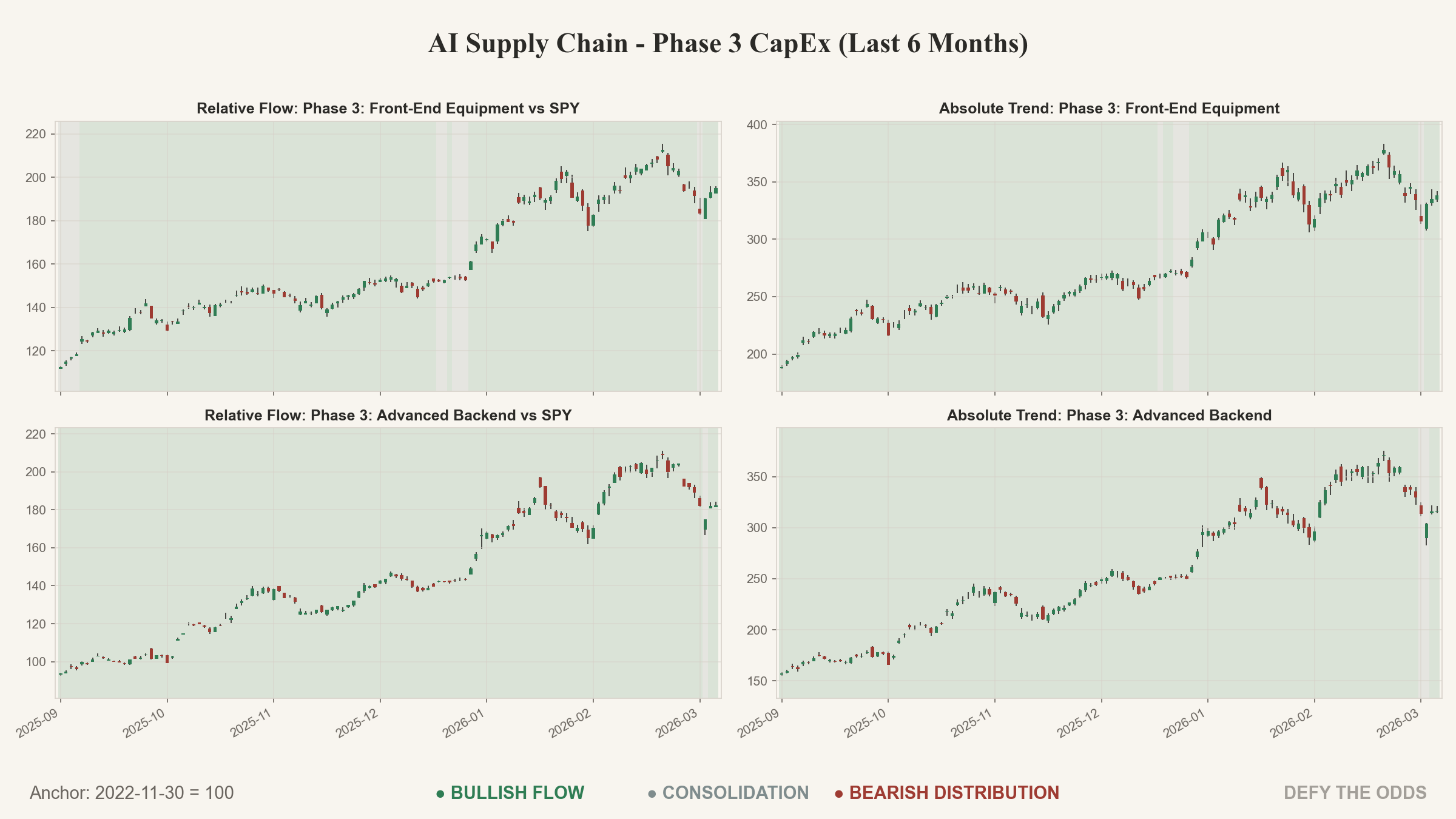
Phase 3: CapEx Front-end fabrication and advanced back-end equipment remain entrenched in a steady, low-volatility bullish regime.
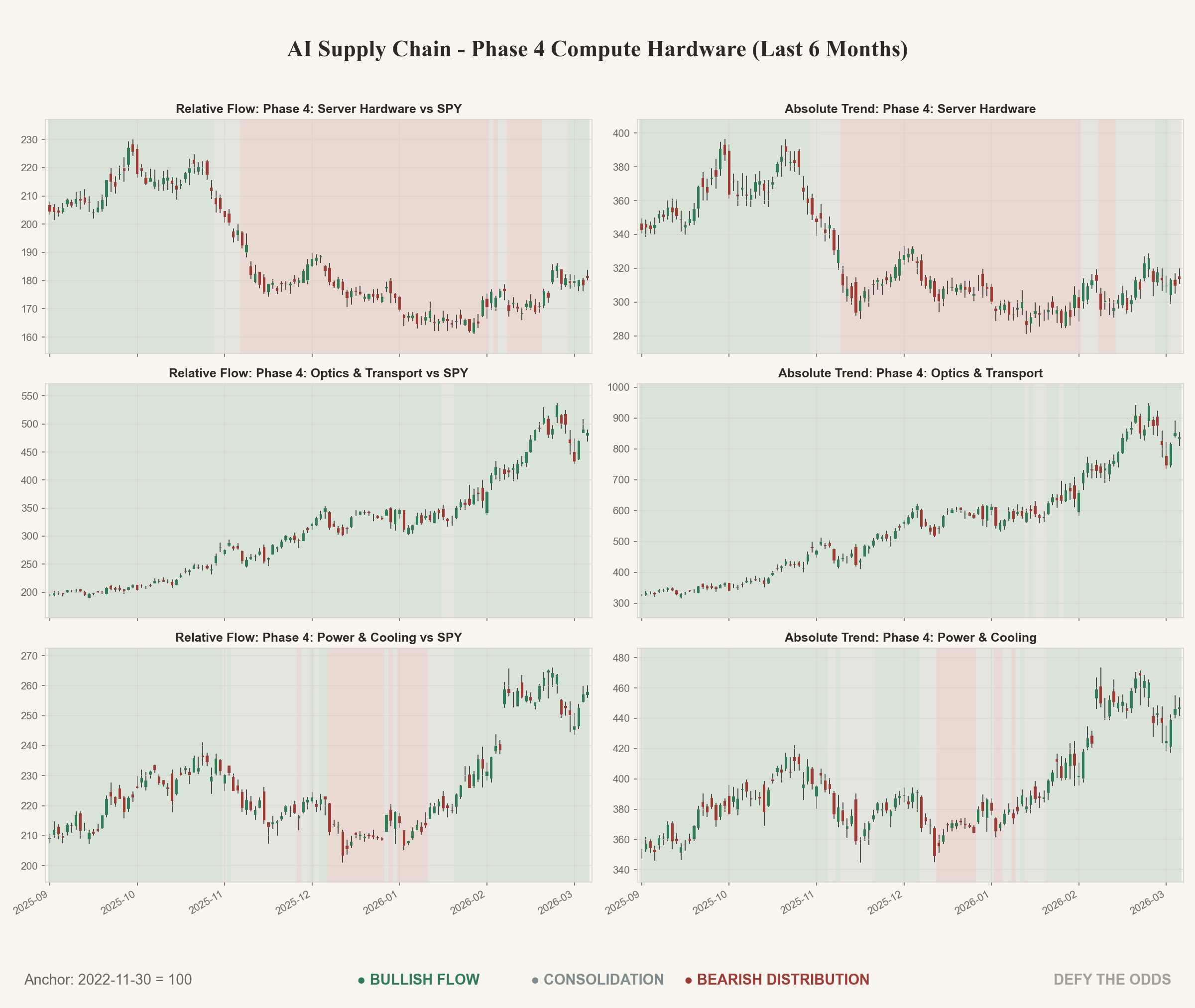
Phase 4: Compute Hardware Optics and power density solutions maintain their relentless leadership, while server hardware has stabilized without yet confirming a definitive breakout.
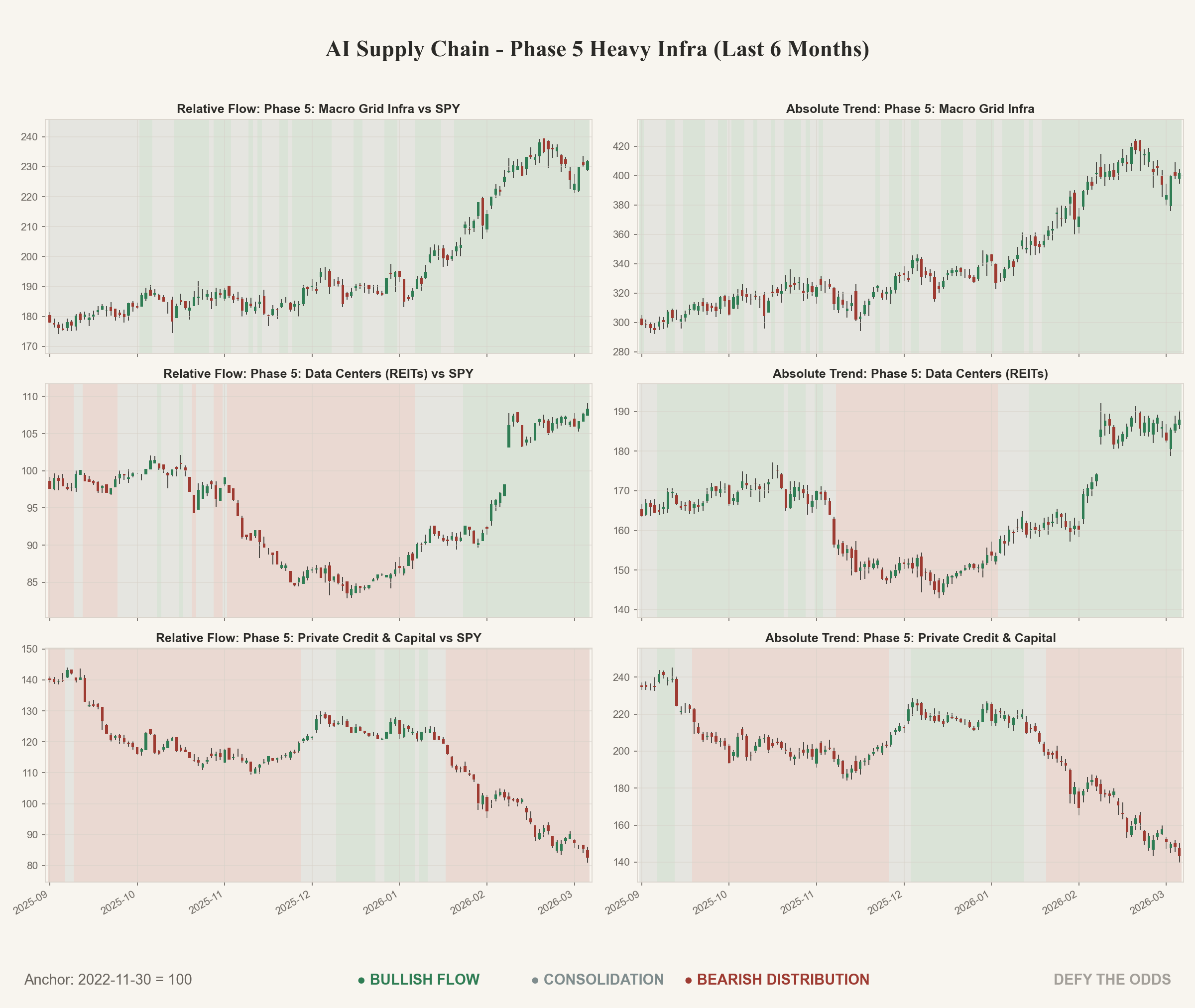
Phase 5: Heavy Infra Grid infrastructure and data center REITs are actively hoovering up capital, directly contrasting with persistent deterioration in private credit.
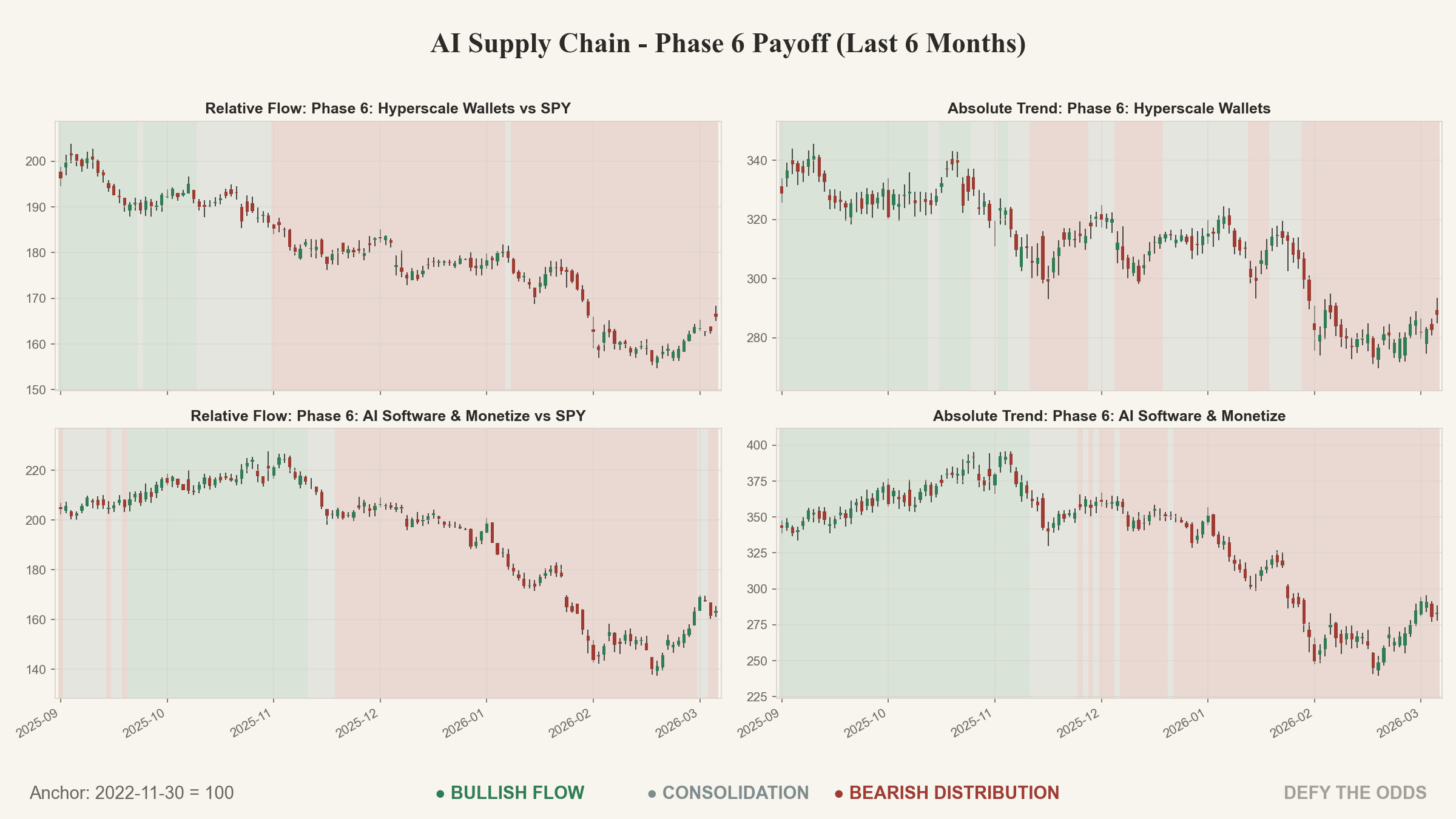
Phase 6: Payoff Hyperscalers and AI software remain locked in bearish distribution as the market strictly demands current profit over future narrative.
What to Buy Now: Where the High-Conviction Bids Are
The Industrial Spine Front-end fabrication and advanced back-end packaging equipment remain the highest-conviction toll collectors of the build-out. These operators command steady institutional premiums based on unavoidable structural necessity.
The Thermodynamic Bottlenecks Optics and power density solutions are absorbing massive capital. As server rack density scales, moving light and extracting heat represent absolute physical limits that buyers are forced to solve.
Heavy Infrastructure Macro grid equities and data center REITs trade strictly on physical scarcity. Gigawatts cannot be downloaded, making strategic asset ownership the ultimate permission to build.
Bottleneck Silicon High-bandwidth memory and foundries are thoroughly outperforming the legacy GPU narrative. Guaranteed manufacturing access and memory throughput now command a higher premium than raw headline compute.
What Still Looks Broken
The monetization layer remains broken. Hyperscalers and AI software bleed performance because revenue realization severely lags massive infrastructure spend. Capital now requires concrete yield over ambition.
Private credit represents a dangerous fault line. The market aggressively bids physical assets but liquidates their financing vehicles. This deteriorating funding mechanism will inevitably choke upstream builders.
Anatomy of the AI Machine: The 6-Phase Journey
Phase 1: The Great Decoupling (Atoms > Bits)
Capital aggressively favors atoms over blueprints, driving a severe momentum impulse in materials and wafers. The market is strictly pricing in tight physical supply and inelastic demand from new fab capacity. Meanwhile, electronic design automation and intellectual property remain trapped in range-bound consolidation. The institutional mandate is absolute: own the physical bottleneck.
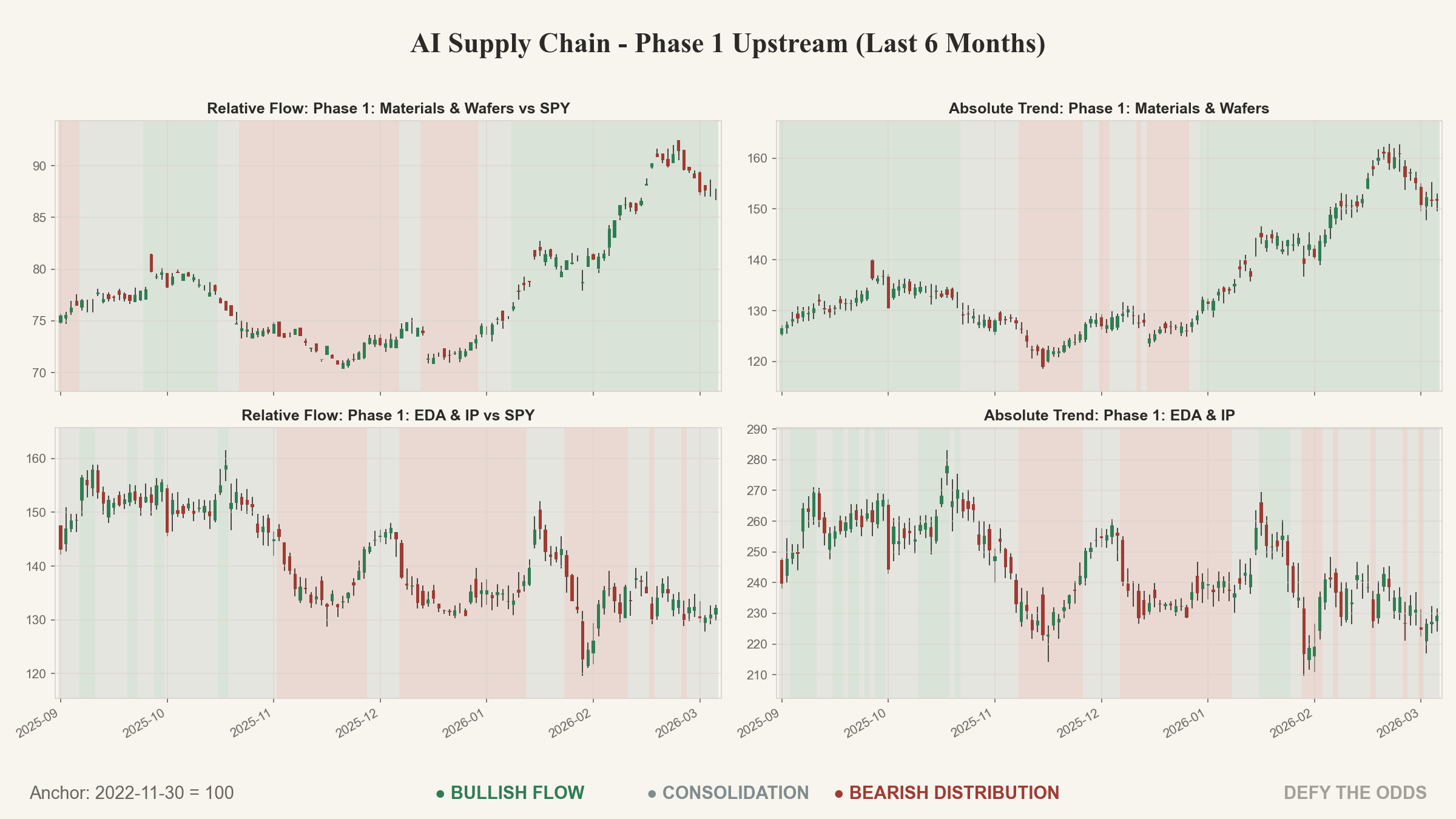
Phase 2: The Silicon Split (Memory Eats Compute)
This remains one of the clearest divergences in the stack. Accelerators and networking have stalled into relative consolidation, while High Bandwidth Memory is registering a severe bullish momentum impulse alongside steady foundries. Institutional capital is strictly paying for memory and fabrication access rather than just raw compute.
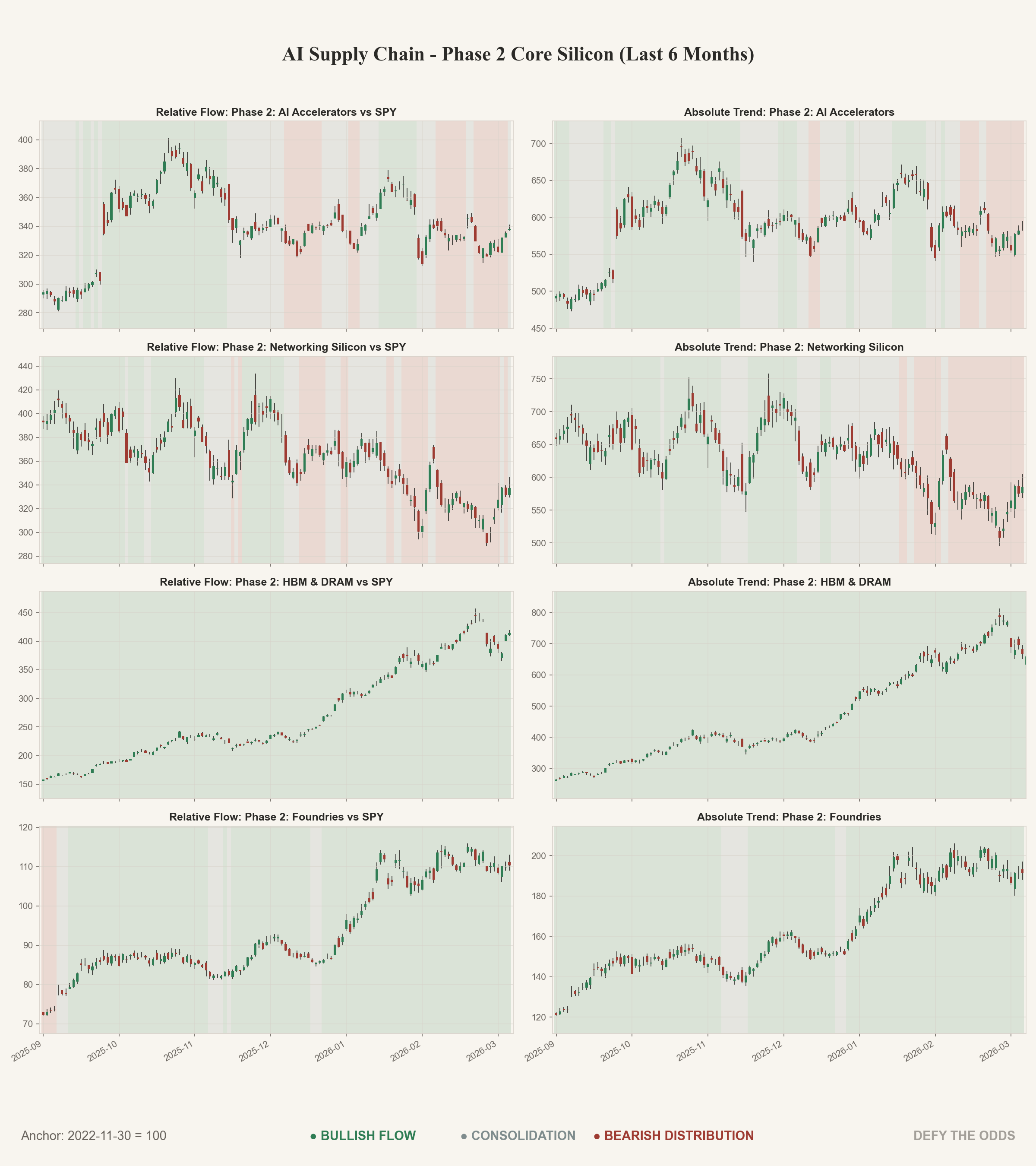
Phase 3: The Inevitable Trade (The Toll Collectors)
Front-end fabrication and advanced back-end packaging equipment remain in persistent, synchronized uptrends. The capital flow here is exceptionally stable and highly convincing, reflecting the structural pricing power of these institutional toll collectors. Capital continues to park itself at the exact center of the physical build-out, rewarding execution with a steady, low-volatility ascent.
Phase 4: Server hardware is looking better by the minute
Capital flow is aggressively demanding solutions to physical bottlenecks, and the internal divergence within this layer is suddenly closing. While optics and power and cooling maintain their relentless structural advance, logging severe momentum impulses across the board, the critical shift this week occurred in server hardware. Rather than merely stabilizing, server hardware relative flow has triggered a severe bullish momentum impulse. Institutional capital is now bidding the entire physical compute stack, signaling that thermodynamic and throughput constraints are forcing urgent deployment across both high-value physics and core assembly.
Phase 5: The Hard Asset Renaissance (Concrete > Paper)
The heavy infrastructure trade is accelerating into a severe structural divergence. Macro grids and data center REITs are registering bullish momentum impulses, cementing their status as one of the most urgent, scarce assets in the physical build-out. However, this extreme demand for concrete and power is directly contradicted by a severe bearish breakdown in private credit. The funding mechanism is actively deteriorating even as physical assets go parabolic, exposing a critical market fault line.
Phase 6: The ROI Reckoning (Show Me the Money)
The monetization layer remains the weakest link in the value chain. Capital continues to bleed from both hyperscale wallets and AI software, with both sub-sectors trapped in persistent bearish distribution. Institutional flow shows zero willingness to pay for future promises without concrete ROI. The market is aggressively discounting the downstream payoff until the software layer proves it can profitably absorb the massive upstream infrastructure build.
Decoding the Smart Money: The 8 Institutional Bridges
The Bridges reveal the real logic of the cycle.
Yield vs. Growth Bridge
The aggressive capital rotation out of software narratives and into yield-bearing hard assets has paused, shifting from bullish expansion into range-bound consolidation. While the structural preference for physical scarcity over uncertain growth remains intact, the immediate momentum of this rotation has stalled as the market digests recent infrastructure valuations.
ROI Bridge
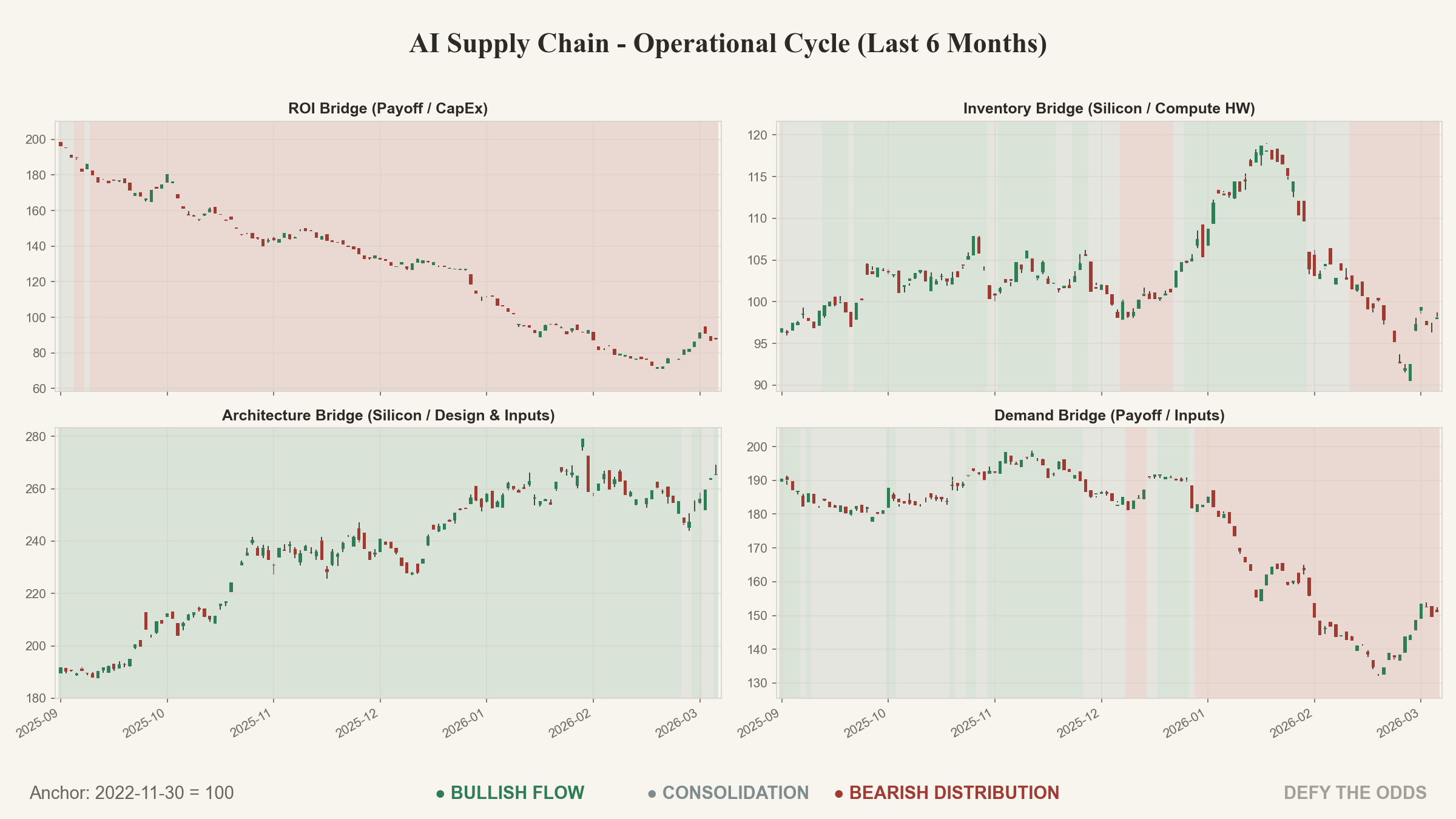
This ratio remains the most dangerous chart in the framework, trapped in persistent bearish distribution. Capital flow dictates that software monetization is entirely failing to keep pace with the compounding cost of building the physical machine. This continued deterioration highlights the core unresolved tension of the entire AI cycle, as the market refuses to fund the downstream layer.
Inventory Bridge
This critical ratio continues to weaken sharply into bearish distribution, implying a major shift in the physical bottleneck. The market is increasingly pricing in sufficient core chip supply relative to the acute, unresolved constraints in downstream packaging, cooling, and server deployment.
Energy Bridge
Despite the prevailing power panic, this ratio just registered a severe bearish momentum impulse, confirming that silicon retains a dominant relative edge over heavy infrastructure. Institutional capital is signaling that high-bandwidth memory and advanced manufacturing remain the absolute central constraints of the cycle, overpowering the broader energy narrative.
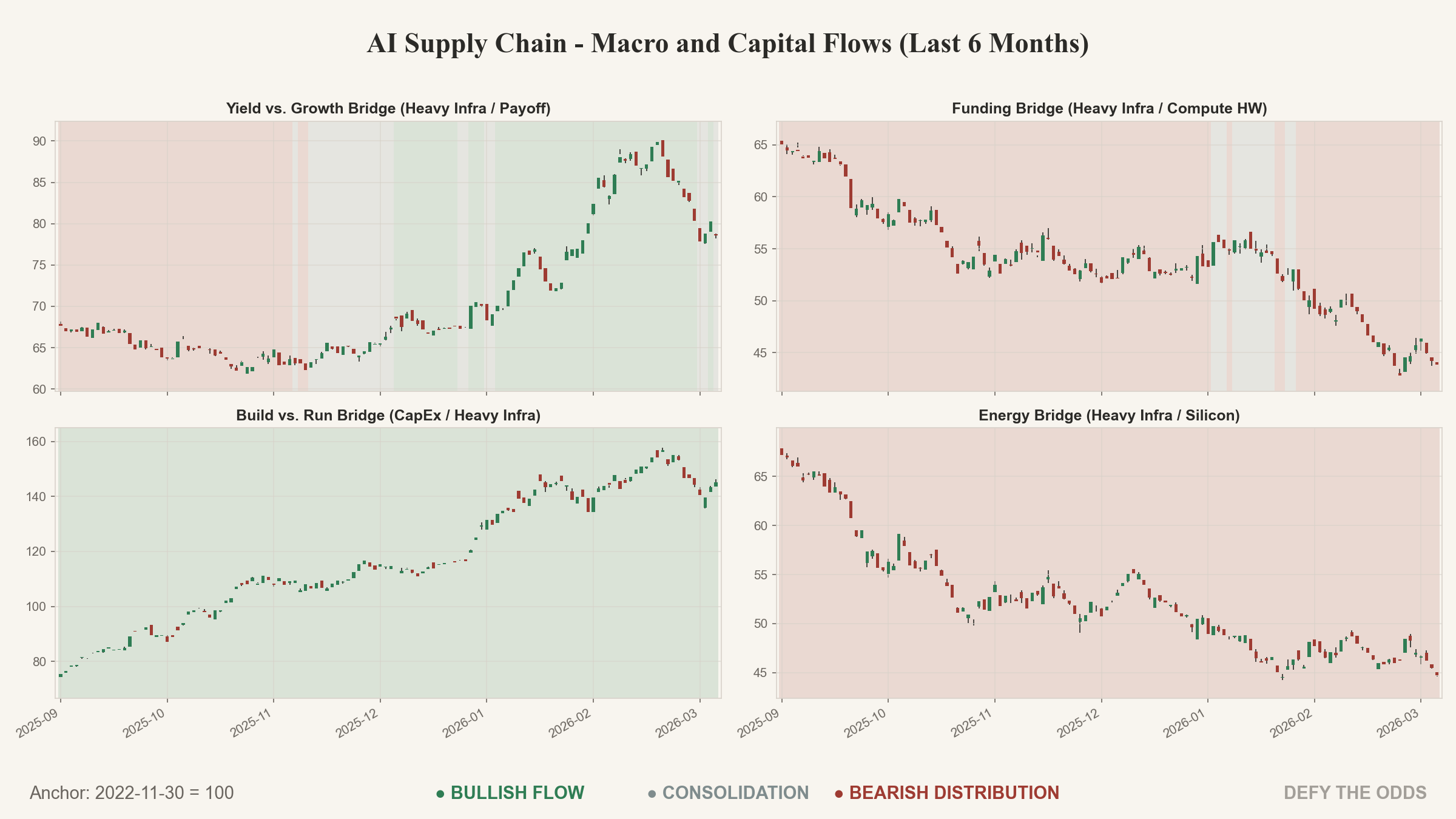
The secondary ratios confirm and accelerate this physical bottleneck thesis
The Funding Bridge flashed a severe bearish momentum impulse, proving that urgent compute hardware deployment is currently drawing capital faster than long-term heavy infrastructure. The Architecture Bridge also triggered a violent bullish breakout, signaling a renewed institutional preference for core silicon winners over upstream design. Meanwhile, the Build vs. Run Bridge maintains its steady bullish trend as fabrication equipment makers command a persistent premium over infrastructure operators. Finally, the Demand Bridge remains firmly bearish, reiterating that end-user software demand is fundamentally too soft relative to the rising cost of the underlying physical system.
What Would Make Us More Optimistic?
A weekly higher low in the payoff layer. Hyperscalers and AI software must demonstrate that monetization is finally catching up to the physical infrastructure build-out.
Stabilization in private credit. The heavy infrastructure trade is currently overpowering deteriorating funding mechanisms, but long-term capital availability must stabilize to sustain the cycle.
A sustained breakout in server hardware. If low-margin assembly begins to confirm the extreme momentum already visible in optics and cooling, the entire compute hardware stack becomes a highly credible momentum engine.
What Would Make Us More Pessimistic?
A deeper technical breakdown in hyperscalers. If the primary buyers of the entire value chain are forced into capital expenditure austerity, the revenue outlook for all upstream phases will deteriorate immediately.
A sharp, high-volume reversal in crowded infrastructure winners. A violent rotation out of data center REITs or macro grid equities would signal that restrictive macro conditions are finally overwhelming the structural AI build-out thesis.
A failed breakout in server hardware. If core assembly stalls while optics and power density solutions become mathematically overextended, the compute hardware trade is fundamentally narrower and more speculative than current flow suggests.
Bottom Line
The dominant institutional signal remains absolute: physical scarcity dictates all AI capital flows. The market is exclusively rewarding the bottlenecks, the physical builders, and the owners of strategic hard assets. Conversely, it continues to ruthlessly punish the downstream layers of the stack where the monetization narrative remains fragile relative to the staggering capital expenditure reality.
Until AI software and hyperscaler returns demonstrably catch up to the cost of the underlying machine, institutional capital will defend its current positioning.
The definitive winners remain high-bandwidth memory, foundries, advanced fabrication equipment, optics, power and cooling, macro grid infrastructure, and data center real assets.
The core unresolved tension of the cycle remains the disconnect between infrastructure cost and software yield. Until that mathematical equation resolves, the market is strictly long the concrete and actively short the promise.
Defy the Odds is soon transitioning to a paid model.
To lock in your access before the transition, Pledge your support today.
(Enter your email to see the pledge options)
Disclaimer: Nothing here is financial advice. These are reflections on macroeconomics and markets, meant to spark ideas and sharpen decision-making. To truly Defy the Odds, think independently, question everything, and do your own homework.