

The Missing Bridge Between Macro and Buying the Right Stock
Introducing the IMM Stock Selection Engine.

For a long time, there has been a gap in the financial analysis industry. A gap that I have been obsessively working to close for Defy the Odds.
The financial world on Substack is split into two tribes.
On one side, you have the Macro Strategists. They write 5,000 brilliant words on liquidity cycles, the dollar, and the yield curve. You nod your head. You understand the world better. But when you get to the end of the email, you are left with the most painful question in investing: “Okay. But what do I actually buy?” Usually, the answer is silence. Or worse, a generic ETF recommendation like “Buy Energy.”
On the other side, you have the Stock Pickers. They analyze balance sheets, earnings reports, and P/E ratios. They find great companies. But they often ignore the ocean the stock is swimming in. They will recommend a perfect value stock right as a liquidity crisis is about to wash it away.
Here is the brutal truth: They are both incomplete.
You can be 100% right about the Macro Theme and still lose money if you pick the wrong Vehicle.
And you can pick the perfect company, but if it is misaligned with the global flow of money, it will drown.
Being right about the macro story is useless if you are wrong about the stock that actually expresses it.
The bridge between these two worlds has been missing. Until now.
The evolution: from MAP to NAVIGATION
Since November, the Intermarket Map (IMM) has been your weekly radar.
Built on 36 intermarket ratios, it has been tracking the invisible currents of the market, showing us exactly how capital is rotating under the surface.

It does not tell you what you want to believe. It tells you what the money is actually doing. Week after week, the IMM gives you:
the current regime fingerprint (risk appetite, credit conditions, growth vs defense)
the top drivers that matter right now
and the kill switches that would invalidate the narrative
But knowing the weather is not enough. For months, we have known where the wind is blowing. Now, we are introducing the tool to sail it.
We are upgrading the IMM from a Market Map to a Stock Selection Engine.
Under the hood: the IMM Stock Selection Engine
We do not rely on gut feel. We rely on data.
The engine scans the entire S&P 1500 universe. This ensures we are fishing in a pool that is broad enough to capture hidden opportunities, but liquid enough to trade institutionally.
The process functions like a funnel:
1. The Macro Scan (The Fingerprint) First, the algorithm looks at the 36 intermarket ratios to define the current “Market Regime.” Is capital flowing into safety or risk? Is it chasing inflation or fearing deflation? It creates a mathematical fingerprint of the current environment.
2. The Behavioral Match Then, it tests every single stock in the S&P 1500 against that fingerprint. We are not looking for stocks that “should” go up. We are looking for structural alignment. If the macro regime is defensive, the code hunts for stocks - regardless of their sector label - that are mathematically trading in lockstep with defensive flows. It isolates the signal from the noise.
3. The “Top Decile” Filter The output is a ranked list. Here is where we are ruthless. We immediately discard the bottom 90%. If a stock is not in the top 10% of statistical alignment with the current money flow, we do not touch it. Being “sort of” right is not enough.
4. The Final Layer, the Human element: The algorithm hands us the top 10% candidates (roughly 150 names). From there, we apply the final “human” overlay. We look for specific technical triggers (Momentum Quality, Relative Strength) and Fundamental stories (Valuation) to pick the absolute winners.
The machine finds the needle in the haystack. We decide if it is sharp enough to buy.
Is It Alpha or Beta?
Academics love to debate whether returns come from Beta (riding the market wave) or Alpha (skill).
Our system targets something different: structural alignment.
Here is where your edge comes from.
The Pure Essence (Concentration)
Most investors buy the diluted average. If the macro signal says “inflation is coming,” they buy an Energy ETF. But that ETF is full of laggards, hedged balance sheets, and companies that do not actually express the theme when it matters.
We do not want a little bit of exposure. We want the concentrate.
We filter out the noise to find the stocks that are brutally aligned with the dominant flows.
The Chameleon Effect
Tickers lie. Labels are often wrong. Sometimes a boring regional bank starts behaving like a high-growth fintech stock. Or a tech giant starts trading with the safety profile of a utility.
Our engine finds these glitches in the matrix.
If our compass points to Growth, but we find a stock inside a “Value” sector that behaves like Growth, that is a mismatch.
And mismatches are where structural alpha gets born.
The Final Form
Think of the market as a massive ocean wave.
Macro analysis tells us when the wave is coming and how big it might be.
Stock selection is the surfboard.
Most investors try to ride a 20-foot wave with a wooden door. They might stay afloat, but it will not be pretty. Our system is designed to find the board that is shaped for this specific wave.
By aligning stock selection with dominant capital flows, we are not gambling on a ticker symbol.
This is the bridge between high-level theory and the Buy button. But let’s see it in action.
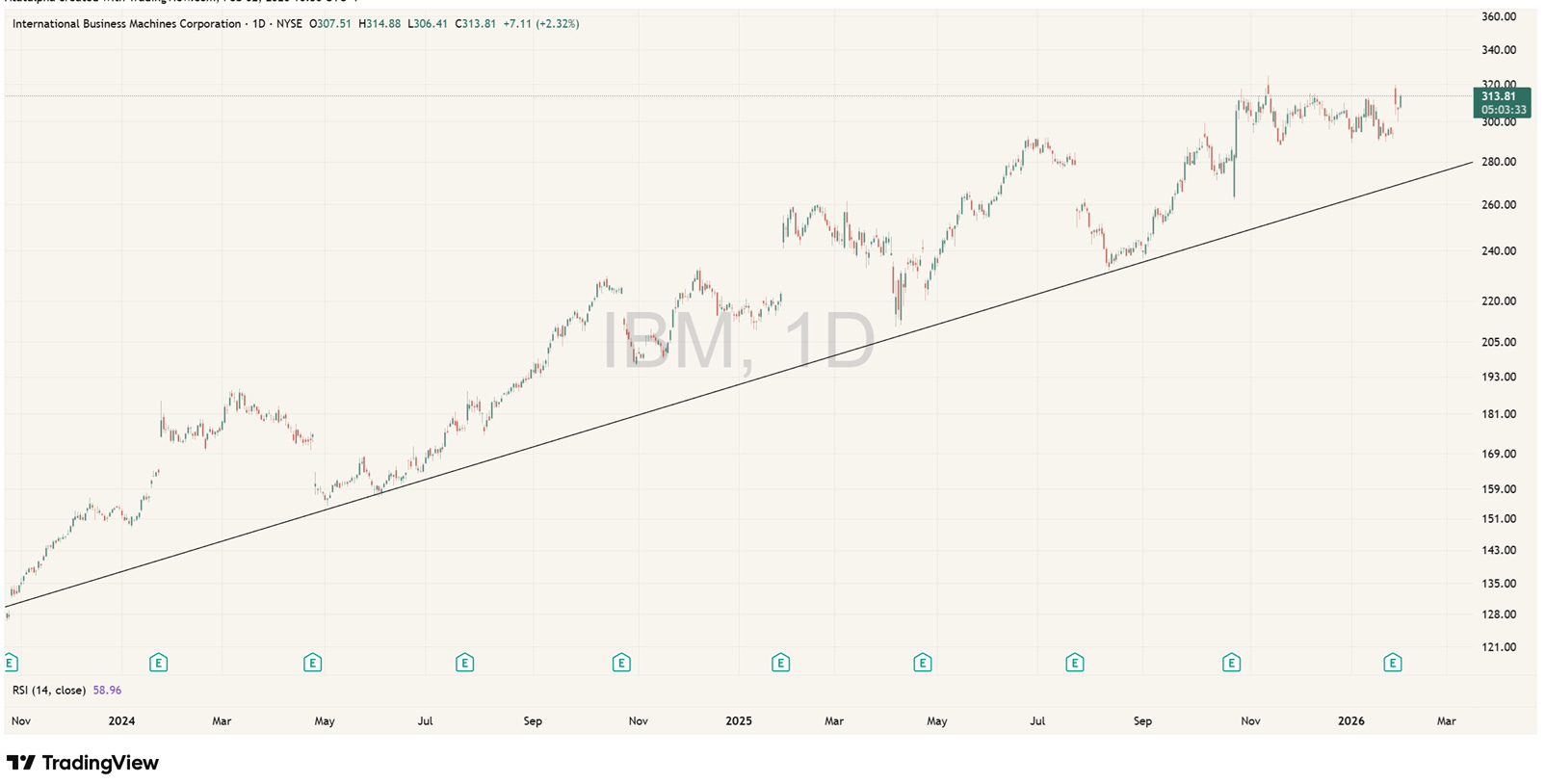
IBM (Profile Match #60) – The Tech Sector’s Safe House
Big Blue is usually considered a dinosaur. In a market obsessed with 50% year-over-year growth and AI revolutions, IBM is often where capital goes to sleep.
But right now, “boring” is the new bullish.
My IMM engine ranks IBM in the top tier (#60 out of 1,500) because it identified a critical shift in the wind: Value is beating Growth, and Quality is beating Junk.
IBM is not trading like a tech stock right now. It is trading like a Bond Proxy.
While the rest of the tech sector hyperventilates over interest rates and P/E multiples, IBM offers a fortress balance sheet and massive free cash flow. It is the “adult in the room.” The algorithm sees that when capital flees from long-duration speculative assets (the “hope” trade), it doesn’t always leave the market—it hides in the stocks that act like savings accounts.
This is a defensive play disguised as a tech holding. We are buying it because in a world where multiples are compressing, cash flow is the only gravity that matters. IBM fits the current “Safety” profile better than almost any other name in the sector.
Kill switch: If the regime flips back to “Risk On” speculation (if SPHB/SPLV goes green and ARKK leads again), IBM loses its edge. In a raging bull market, this stock is dead weight. But in a choppy, discriminatory market? It is armor.
DIOD (Profile Match #6) – The Blue-Collar Chip
If you mention “semiconductors” at a dinner party today, everyone assumes you are talking about AI. Everyone wants the next Nvidia. Everyone wants the lottery ticket.
But my engine flagged Diodes Inc. (DIOD) as the #6 strongest match in the entire S&P 1500 for a very different reason.
DIOD is the “working class” semiconductor. It does not power ChatGPT. It powers the real economy. It makes the boring, essential components that go into automotive systems, industrial automation, and smart manufacturing.
The IMM fingerprint tells a fascinating story here.
The algorithm identified a rare dual-signal:
It loves the cycle: DIOD is moving in perfect lockstep with the broad semiconductor leadership (SMH/XLK: +0.9).
But it hates the hype: It is structurally decoupled from speculative trash (ARKK/QQQ: -0.7).
This is the definition of a “Discriminatory Bull Market.” Capital is rotating out of “hope” and into “hardware.”
Buying DIOD here is a bet on the industrialization of technology. It is a “hard hat” trade masquerading as a tech stock. While the tourists are trying to guess which AI software start-up will survive, we are buying the company that builds the plumbing for the factory floor.
Kill switch: If the market narrative shifts back to pure speculation (ARKK leads) or if the industrial cycle rolls over (SMH cracks), DIOD loses its structural protection. Until then, we ride the quiet trend.
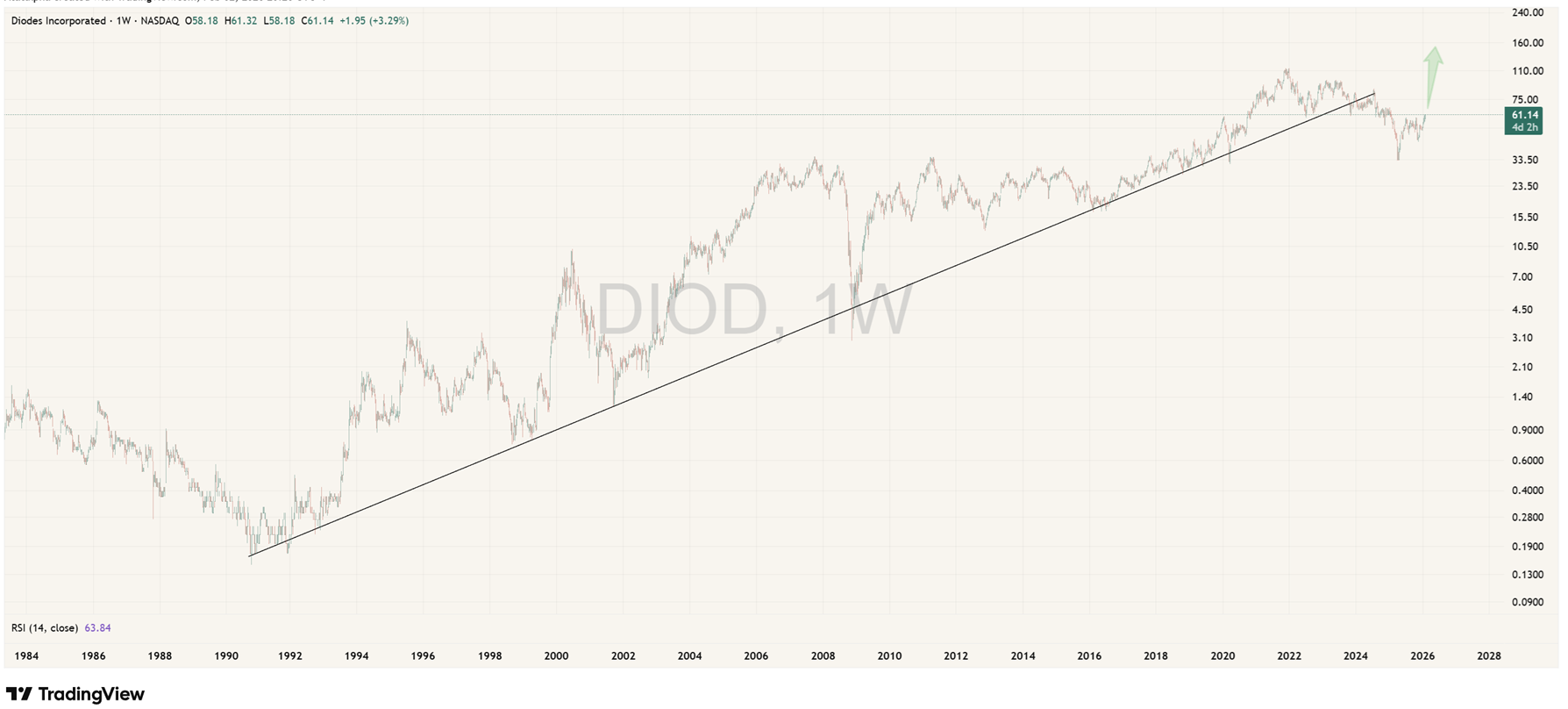
And yes, I initiated both positions today, 3% each.
The ghost in the machine
Before you follow the signals, let’s be clear about one thing.
This is not a hallucinating AI bot guessing ticker symbols.
AI helped me build the architecture. It optimized the code. It accelerates the processing power. But it did not invent the strategy.
The logic inside the IMM is 20 years of market tuition, scars, and screen time, hardened into immutable mathematical rules. The machine does not “think.” It executes my thinking. Just faster, deeper, and without emotion.
The variables are mine.
The logic is mine.
The supervision is mine.
This is not Artificial Intelligence. It is Automated Experience.
And from now on, it is working for you.
What to expect going forward
We are turning the engine on. Here is the operational rhythm you can expect from Defy the Odds:
1. The Weekly Signal Every week, I will curate the top profile matches generated by the IMM. These are not random ideas. These are high-probability swing setups aligned with the macro regime. I eat my own cooking. I trade these signals. If I share a name, assume I am buying it. If I do not buy a specific ticker, it is only because my capital is already fully deployed in a correlated asset, never because I lack conviction.
2. The Structural Deep Dives Most signals are tactical swing trades. But occasionally, the IMM flags something bigger—a massive structural misalignment or a “fat pitch” that warrants a multi-month or multi-year campaign. When the data screams this loud, I will publish a Deep Dive. These will be comprehensive breakdowns of the thesis, the fundamentals, and the macro tailwinds.
3. One More Thing... The “Micro Sniper”
We are not done. The IMM is the heavy artillery - it identifies the broad Macro Regime alignment.
But I have been working on a second engine. A Machine Learning-based stock selection model designed to hunt for specific valuation anomalies and technical patterns that fly under the radar.
I will be unveiling this second model later this week.
Watch your inbox.
Institutional-grade alpha cannot remain free forever
Why? Because alpha decays. If everyone has the map, the map becomes useless. If 100,000 people crowd into the same trade at the exact same price, the edge disappears.
I am sharing this openly now for one reason: Proof of Concept. I want to show you the receipts. I want you to see the engine work in real-time.
But soon, the IMM and the specific trade signals it generates will move behind a paywall.
This is necessary not just to cover the costs of the data and the architecture, but to protect the integrity of the signals for serious investors. We are building a weapon, not a toy. And weapons are not distributed for free.
Enjoy the open access while it lasts. The gates are closing soon.
Disclaimer: Nothing here is financial advice. These are reflections on macroeconomics and markets, meant to spark ideas and sharpen decision-making. To truly Defy the Odds, think independently, question everything, and do your own homework.

This fills a real gap tbh. I've noticed most macro folks either go silent when it comes to execution or just say "buy the sector ETF" which feels lazy. The idea of filtering stocks based on behavioral alignmet with capital flows is sharp. Ran into this issue last year when I nailed the reflation call but bought all the wrong names.